Quantum transduction
Quantum hardware, like its classical counterparts, needs interconnects between processing, memory and communication modules. We use emerging materials and new device architectures to develop high-fidelity quantum transducers between electrical, mechanical, spin and optical quantum states.
Recent topics
-
Integrated electro-optic transducers in thin-film lithium niobate
Electro-optic devices in thin-film lithium niobate can convert signals directly between microwave and optical frequencies over a broad bandwidth. We develop fully integrated, traveling-wave superconducting electro-optic transducers and study the microwave loss, including piezoelectric radiation, that limits their efficiency.
In collaboration with Mengjie Yu
-
Resonantly enhanced electro-optics in quantum wells
Near an exciton resonance, an electric field strongly shifts the optical absorption of a semiconductor quantum well (the quantum-confined Stark effect), giving an electro-optic response far larger than in bulk crystals. We study the fundamental trade-off between this enhanced nonlinearity and the optical absorption that comes with it, toward transducers that need less pump power and shorter devices.
In collaboration with Feng Wang
-
Electromechanical quantum systems
Mechanical resonators couple to both superconducting circuits and light, which makes them natural intermediaries for quantum transduction. We control mechanical motion at the level of single phonons, study what limits the coherence of mechanical modes, and explore their use as quantum memories.
Research highlights
-
Nature 2020
Superconducting qubit to optical photon transduction
We convert the microwave-frequency excitation of a superconducting transmon qubit into an optical photon, using a nanomechanical resonator that couples to the qubit piezoelectrically and to light through radiation pressure. Detecting the emitted photons over an optical fiber, we record the qubit’s quantum Rabi oscillations, a step toward optical networks that link remote superconducting quantum processors.
Read the paper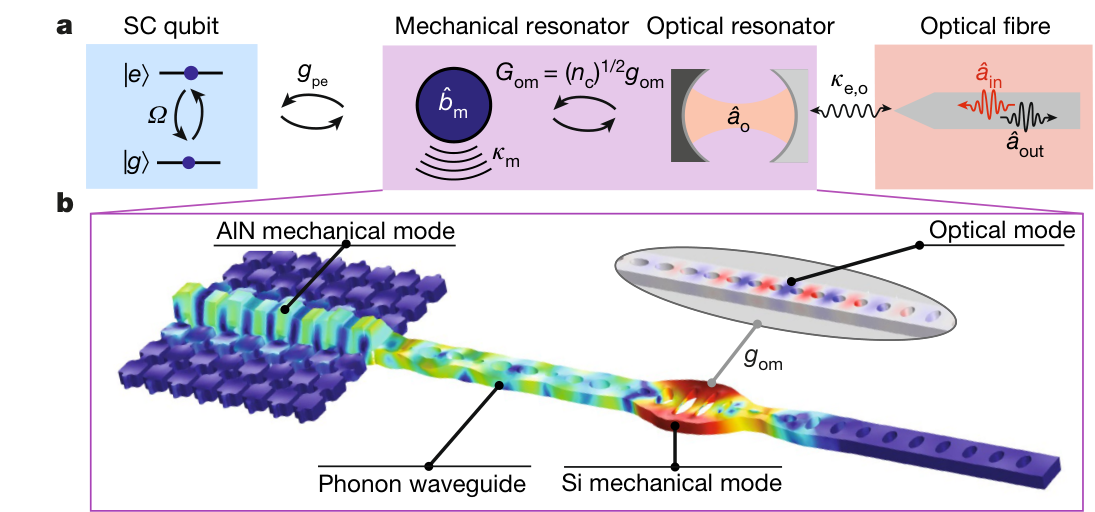
Recent group publications on quantum transduction
-
arXiv:2407.15387 (2024)
@unpublished{jahanbani_nanomechanical_2024,
  title = {A {Nanomechanical} {Atomic} {Force} {Qubit}},
  url = {http://arxiv.org/abs/2407.15387},
  doi = {10.48550/arXiv.2407.15387},
  author = {Jahanbani, Shahin and Zhang, Zi-Huai and Hua, Binhan and Godeneli, Kadircan and Müllendorff, Boris and Zhang, Xueyue and Zhou, Haoxin and Sipahigil, Alp},
  month = jul,
  year = {2024},
  note = {arXiv:2407.15387 [quant-ph]},
  arxiv = {2407.15387}
}
Silicon nanomechanical resonators display ultra-long lifetimes at cryogenic temperatures and microwave frequencies. Achieving quantum control of single-phonons in these devices has so far relied on nonlinearities enabled by coupling to ancillary qubits. In this work, we propose using atomic forces to realize a silicon nanomechanical qubit without coupling to an ancillary qubit. The proposed qubit operates at 60 MHz with a single-phonon level anharmonicity of 5 MHz. We present a circuit quantum acoustodynamics architecture where electromechanical resonators enable dispersive state readout and multi-qubit operations. The combination of strong anharmonicity, ultrahigh mechanical quality factors, and small footprints achievable in this platform could enable quantum-nonlinear phononics for quantum information processing and transduction.